

The winter of 1643 settled over Manningtree like a damp woolen cloak. Smoke curled from thatched roofs, clinging to the low sky as though afraid to rise. In those months, fear ran as thick as the mud in the lanes, and gossip moved faster than any horse. It was in this small Essex town that Elizabeth Clarke, an old widow of little means and one leg, came to be spoken of, her name carried from hearth to hearth as though it were a curse in itself.
Elizabeth had lived a long life by the standards of her day. Her small, crooked cottage perched on the edge of Manningtree, where the woods began and the crows gathered in rows like watchful jurors. She had long been known as strange, odd, but not dangerous. She muttered to herself, kept to her own company, and sometimes begged for alms when her small parish allowance did not stretch far enough to feed her. Such oddities were tolerable in times of peace. But England was at war with itself, soldiers marched across the countryside, loyalties questioned at every turn. Unease seeped into the seams of ordinary life. And in times of fear, people sought someone to blame for the misfortunes.
John Rivet, a tailor of some repute in Manningtree, had never thought much about Elizabeth Clarke one way or another. His wife, however, had grown increasingly frail that winter, pale, wan, and too weary even to rise some mornings. The Rivets had sought the help of an apothecary, then of prayer, then of more prayer, but her weakness persisted. When neighbours suggested that mischief, not illness, plagued the household, John Rivet dismissed the idea. Yet even he could not deny how swiftly the rumor traveled, Elizabeth Clarke had cursed his wife.
The supposed curse, as it was later described, began with a quarrel over alms. Elizabeth had asked the Rivets for relief, bread, or the coin to buy it and had been turned away. Soon after, Rivet’s wife took ill. Such a sequence, to the fearful mind, needed no further explanation.
By the turn of the year, murmurs about Elizabeth had grown bold enough to reach the ears of a young man newly gaining reputation for his zeal in uncovering the Devil’s servants, Matthew Hopkins. He was not yet infamous, not yet the “Witchfinder General” that history would remember, but he was already honing the craft that would earn him the title. Manningtree was his first proving ground.
Hopkins, along with his associate John Stearne, began to take testimony from the townspeople. The winter nights, long and dim, served well for fear to deepen its roots. Neighbours recounted odd encounters with Elizabeth Clarke, her mutterings, poverty, and occasional sharp tongue. Some claimed she had familiars, creatures that suckled from hidden teats on her body to do her bidding. Others said she was visited by imps whose names, they insisted, were known to her. These tales grew in the telling until they no longer resembled the frail old woman who limped through the muddy lanes.
When Hopkins visited her cottage, Elizabeth Clarke offered little resistance. She could not, by then she was in her late sixties, thin as a reed, and in no state to withstand the relentless pressure he applied. Hopkins watched her for hours, prodding, questioning, depriving her of rest. Such methods, later criticized as coercive even by the standards of the day, were intended to break her resolve, and they did.
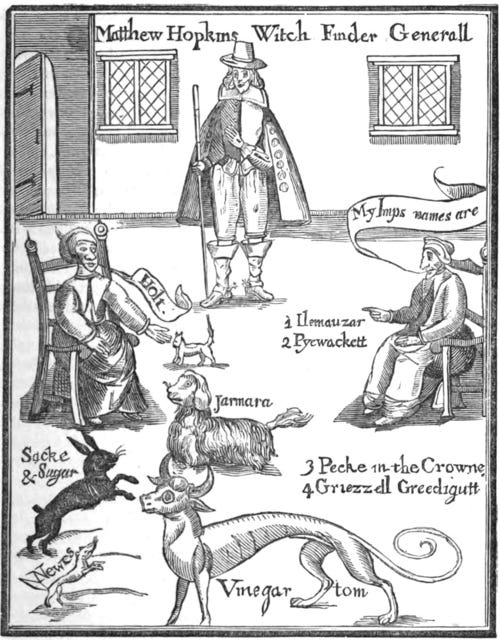
In her exhaustion, Elizabeth muttered about creatures that came to her at night, a white kitten, a greyhound-like dog, a ferret. Hopkins seized upon these ramblings as confession. He demanded names, and she offered them, whether to please her tormentors, or because delirium conjured them, none could say. She spoke of “Holt,” “Jarmara,” “Sack and Sugar,” and other creatures that Hopkins later described as demons in animal shape. The admissions, extracted under duress, were recorded as truth.
But a witch, Hopkins believed, did not work alone. And so he pressed her further, Who were her accomplices?.
It was in the weeks that followed that Elizabeth Clarke, frightened, exhausted, and perhaps seeking to end her ordeal, named other women in the region, Anne West and her daughter Rebecca, Elizabeth Gooding, Ellen Billing, Anne Leech, and others. Some names she offered freely, others under prompting, but each accusation struck like a spark on dry tinder. Hopkins, assured now that a coven operated in Manningtree, moved swiftly.
The women Elizabeth named were seized and examined. Many were as poor as she was, widows or labourers with no power or means to shield themselves. Under the scrutiny of the Witchfinder, they too confessed, some out of terror, others because they believed resistance futile. One by one, their stories formed a narrative Hopkins could hold aloft as proof of a grand conspiracy.
The town, once uneasy, now buzzed with a kind of righteous fervour. What had begun as a sick woman in the Rivet household exploded into a conviction that evil infested Manningtree, creeping in through unguarded doors, slipping into dreams. Each accusation reinforced the next. Each confession confirmed the villagers’ darkest suspicions.
Elizabeth Clarke, weak and resigned, became the centerpiece of this grim tapestry. Hopkins portrayed her as the first and oldest of the witches, the root from which the others sprang. And in that portrayal, he sealed not only her fate, but theirs.
By the spring of 1645, trials were held in Chelmsford. The justices, some sincere, others swept up in the momentum, heard the testimonies Hopkins and Stearne presented. They heard of familiars, secret meetings, and malefic charms cast upon neighbours. They heard confessions, wrung from bodies and minds worn to breaking. They heard the Rivets speak of the illness that had begun it all.
And the court believed.
Elizabeth Clarke was hanged, the first execution attributed to Hopkins’s campaign. Several of the women she had named met the same fate soon after. Manningtree, which had sought relief from its fears, found none. The executions did not ease the town’s anxieties, if anything, they confirmed that witches had indeed lived among them. And fear, once given such fertile soil, grew wild.
As the bodies were carted away and the crowds dispersed, Manningtree settled into a troubled quiet. Rivet’s wife eventually recovered, not quickly but in the slow, uneven way of many common ailments. Her improvement, once seized upon as proof of witchcraft, now offered no comfort. If her sickness had been natural, then the cost of the winter’s hysteria was too terrible to bear.
Matthew Hopkins, for his part, left Manningtree with newfound confidence in his vocation. The events surrounding Elizabeth Clarke became the foundation of his future pursuits, the method he would repeat in town after town until hundreds stood accused across East Anglia. But Manningtree remained, in its way, the first stone cast into a pond whose ripples would disturb England for years.
Further reading;
Elizabeth Clarke (c. 1565–1645), alias Bedinfield, was the first woman persecuted by the Witchfinder General, Matthew Hopkins in 1645 in Essex, England. At 80 years old, she was accused of witchcraft by local tailor John Rivet. Hopkins and John Stearne took on the role of investigators, stating that they had seen familiars while watching her. During the process, she was deprived of sleep for multiple nights before confessing and implicating other women in the local area. She was tried at Chelmsford assizes, before being hanged for witchcraft.
Additional dark chapters in the annals of human history.