

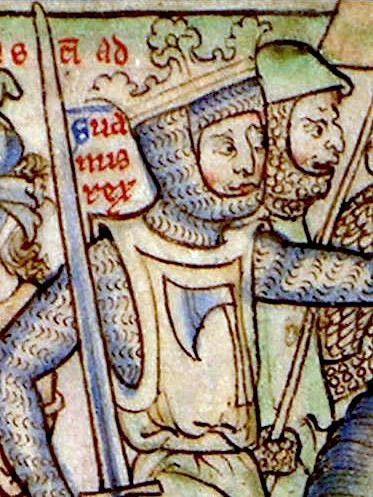
The storm began before midnight, a black, howling tempest that tore across the Danish coast. In the wooden hall of King Harald Bluetooth, a child’s cry mingled with the wind.
The old seeress who attended the birth raised her head from the cradle.
“He was born beneath the wrath of Thor,” she whispered, eyes wide. “This one will shake kingdoms.”
They named him Sweyn, but the people called him Forkbeard, for the split that later marked his chin like twin blades.
The hall smelled of smoke, salt, and honeyed mead. Sweyn sat beside his father’s throne, watching as Harald Bluetooth welcomed priests from across the sea, pale men in black robes who carried books instead of swords.
“They say their god died nailed to a tree,” Sweyn muttered to his men. “And yet my father kneels to him.”
He was twenty winters old, his beard still light but his eyes sharp as an axe edge. Harald had bound Denmark in the name of the White Christ, building churches where the old stones of Odin once stood. To Sweyn, it was treachery, a surrender of the soul of the North.
That summer, Sweyn rose in rebellion.
His banners, black as raven wings, swept across the land. Father and son met at the mouth of the Limfjord, where the mist rolled low and the gulls screamed like lost spirits.
When the battle was done, Harald Bluetooth was carried from the field, pierced by a spear. Some said Sweyn’s own hand cast it, others said it was fate.
Either way, the old king’s line ended there, and a new one began.
As king of Denmark, Sweyn ruled from his seat at Roskilde, a hall of oaken pillars and whale-bone carvings. He restored the temples to Thor and Freyr, cast out the foreign priests, and rebuilt his war fleet, sleek longships with prows carved like dragons.
Across the sea, the land of England beckoned. It was rich, divided, and ruled by a king named Æthelred, whom the Danes mocked as the Unready, the man ill-advised. For years, Æthelred had paid the Vikings tribute, Danegeld, to keep them away. Sweyn took the silver and smiled.
“We’ll not be bought like fishwives,” he told his captains one winter night. “If he would pay for peace, let him pay with his crown.”
The oars bit water, the sails unfurled, and the horizon burned red with sunrise and ambition.
In 1002, word reached Denmark that Æthelred had ordered the slaughter of every Dane in England. It became known as the St. Brice’s Day Massacre, men, women, children, even those who had lived there for generations. Among them was Sweyn’s own sister, Gunhild, said to have been burned alive inside a church.
The next spring, Sweyn’s vengeance came with the tide.
From the Humber to the Thames, his fleet descended. Towns were torched, abbeys plundered, and the English fled before the dragon-prowed ships. Monks wrote of “a great heathen army, more cruel than any before.”
Sweyn read those words and smiled.
He made alliances with Norse jarls, even the famous Olaf Tryggvason before they became enemies. He took hostages, demanded tribute, and grew richer than any Scandinavian king before him.
By 1013, after years of relentless raids, his fleet, hundreds strong, entered the Thames itself. London fell, and the nobles of England swore fealty. Æthelred fled to Normandy, and for the first time in history, a Viking sat upon the throne of England.
Sweyn Forkbeard, King of England, Denmark, and Norway, ruler of the North Sea Empire.
By January 1014, his men encamped at Gainsborough in Lincolnshire. The winter wind howled through the camp like a dying god. One night, as his guards dozed, Sweyn staggered from his tent, eyes wide with madness.
“Saint Edmund is here!” he cried to the cold. “He strikes me down!”
Before dawn, Sweyn Forkbeard was dead.
Some said his heart burst. Others whispered of poison. But those who were there swore they saw a shadow pass across the moon at the very moment he fell.
His death threw the kingdom into chaos. The English briefly recalled Æthelred, but the tide of fate had already turned. Sweyn’s son, Cnut, returned two years later, conquering England anew and ruling it for two decades.
And yet, in every mead hall from York to Jutland, when the skalds raised their voices to sing of kings who defied gods and crowns alike, they sang first of Sweyn Forkbeard, the mighty sea king who dared to seize three thrones.
Further reading;
Swein Forkbeard (also Sweyn, died 3 February 1014) was King of Denmark from 986, King of England for five weeks from December 1013, and King of Norway from 999/1000, all until his death in 1014. He was the father of King Harald II of Denmark, King Cnut the Great, and Queen Estrid Svendsdatter.