

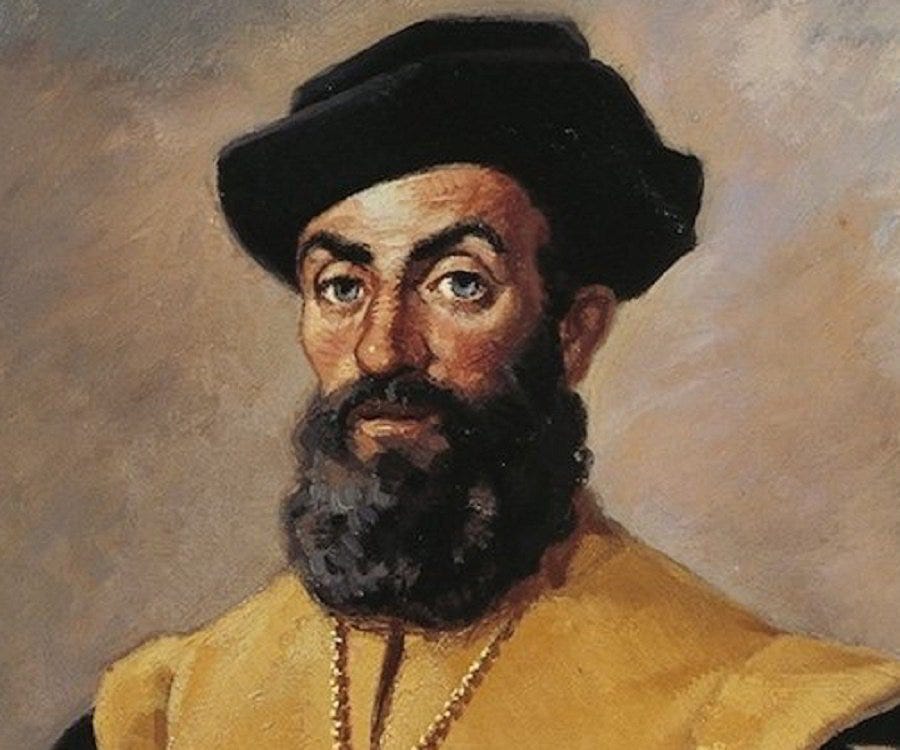
Ferdinand Magellan was one of the most determined and controversial explorers in the history of seafaring. His voyage began as a bold gamble and became one of the greatest journeys ever attempted by humans. Though he did not live to see its end, the expedition he led completed the first circumnavigation of the Earth, permanently changing humanity’s understanding of the world.
Ferdinand was born around 1480 in northern Portugal, most likely in the region of Sabrosa. Portugal at the time was a rising maritime power, sending ships along the coast of Africa and across the oceans in search of trade routes and riches. Magellan grew up in a world where adventure and opportunity lay beyond the horizon.
As a young man, he entered service at the royal court of Manuel I of Portugal. But court life was only the beginning. Soon Magellan joined Portuguese naval expeditions sailing eastward toward the spice-rich lands of Asia.
The early sixteenth century was driven by one obsession, spices. Nutmeg, cloves, and cinnamon were incredibly valuable in Europe, used to flavour food, preserve meat, and even as medicine. These spices came primarily from the distant islands of Southeast Asia known as the Maluku Islands. Controlling the route to these islands meant immense wealth.
Magellan sailed with Portuguese fleets to India and Southeast Asia, gaining experience in navigation, warfare, and diplomacy. During these voyages he traveled to places such as Goa and Malacca, where he witnessed the bustling trade networks connecting Asia, Africa, and the Middle East.
Yet despite his service, Magellan eventually fell out of favor with the Portuguese king. When he proposed a bold plan, to reach the Spice Islands by sailing west instead of east, King Manuel rejected him, but Magellan refused to give up.
Magellan took his idea to Portugal’s rival, Spain. There he found support from the young king Charles V. At the time, Spain and Portugal had divided the world between them through the Treaty of Tordesillas. According to this agreement, Spain controlled lands to the west while Portugal dominated routes around Africa. Magellan argued that the Spice Islands might lie within Spain’s half of the world if approached from the west. If Spain could reach them by sailing across the Atlantic and around the Americas, the Spanish crown could claim enormous profits. Charles V agreed to fund the expedition.
Magellan, now sailing under the Spanish flag, prepared a fleet of five ships,
Trinidad, San Antonio, Concepción, Victoria, and Santiago. In September 1519, the fleet departed from Seville, heading toward the unknown.
The ships sailed down the coast of Spain and across the Atlantic Ocean to South America. By December 1519 they reached the coast of what is now Brazil and entered the wide waters of Rio de Janeiro. Magellan’s goal was clear, find a passage through the American continent that would lead to another ocean beyond it.
But the journey quickly became dangerous.
The fleet continued south along the vast and unfamiliar coastline of South America, searching for a channel or strait. As winter approached in 1520, the ships anchored in a remote harbour known today as Puerto San Julián. It was here tensions erupted.
Many of the Spanish captains distrusted Magellan. After all, he was Portuguese commanding a Spanish fleet, and the voyage had already taken months with no success. During the cold winter at San Julián, several captains launched a mutiny against him. Magellan acted swiftly and ruthlessly. Loyal sailors seized the rebellious ships, and the mutiny was crushed. One captain was executed and another left stranded on the shore.
The expedition continued, but losses mounted. One ship, the Santiago, was wrecked during a reconnaissance mission along the coast.
Still Magellan pressed onward.
Finally, in October 1520, the fleet discovered a narrow and winding passage through the southern tip of South America. This channel would later be named the Strait of Magellan. Navigating it was slow and treacherous. The strait twisted between towering cliffs and icy waters. Storms battered the ships, and the crews feared they might be trapped forever in the maze of channels.
During the passage another disaster struck, the ship San Antonio deserted the expedition and sailed back to Spain. But the remaining vessels continued.
After more than a month of careful navigation, Magellan’s ships finally emerged into a vast, calm ocean. Because the waters appeared peaceful compared with the storms of the Atlantic, Magellan named it the Pacific Ocean, from the Latin word pacificus, meaning peaceful.
The calm name, however, proved deceptive.
Magellan had no idea how enormous the Pacific truly was. European maps at the time dramatically underestimated its size. For more than three months the fleet sailed across the empty ocean without reaching land. Food supplies ran dangerously low. Sailors survived on spoiled biscuits, rats, and even leather from the rigging. Many died from starvation and scurvy.
Finally, in March 1521, the fleet reached the islands of the western Pacific. They landed first at Guam before continuing toward the Philippine archipelago. For the exhausted sailors, land was salvation.
Magellan arrived in the islands now known as the Philippines in April 1521. There he met local rulers and attempted to form alliances. One of the most important encounters was with Rajah Humabon, the leader of the island of Cebu. Magellan helped convert Humabon and many of his followers to Christianity.
But Magellan soon became involved in a local conflict.
A rival chief named Lapulapu refused to submit to Humabon’s authority. Magellan decided to support his new ally by attacking Lapulapu’s forces. This decision would prove fatal.
On April 27, 1521, Magellan led a small force of about sixty men onto the shores of Mactan Island. The plan quickly fell apart. Shallow waters prevented the ships from approaching close enough to support the landing. Magellan and his men had to wade through the surf under attack. Lapulapu’s warriors, numbering in the hundreds, surrounded the Europeans. Armed with spears, shields, and swords, they overwhelmed the small landing party. Magellan fought bravely but was struck repeatedly and killed on the beach.
The leader of the expedition was gone.
Despite Magellan’s death, the voyage was not over. The surviving crew continued westward, determined to reach the Spice Islands and return to Spain. Eventually they arrived at the Maluku Islands and loaded their ships with valuable cloves. By this point only two ships remained. One of them, the Victoria, set sail westward across the Indian Ocean under the command of Juan Sebastián Elcano. After a brutal journey around the southern tip of Africa and across the Atlantic, the Victoria finally returned to Spain in September 1522.
Out of the original 270 sailors who had departed three years earlier, only 18 men completed the voyage. But they had accomplished something extraordinary, they had circled the entire globe.
Although Magellan did not survive the expedition, his leadership made the voyage possible. He proved that the Earth could be circumnavigated by sea. Magellan’s expedition also accelerated the age of global exploration and trade, linking Europe, the Americas, and Asia more tightly than ever before.
Today his name lives on in the Strait of Magellan and in the history of exploration itself. Though controversial and complex, Ferdinand Magellan remains one of the boldest navigators ever to sail the oceans.
His voyage transformed the map of the world, and humanity’s understanding of its place upon it.
Further reading:
Ferdinand Magellan (c. 1480 – 27 April 1521) was a Portuguese explorer best known for planning and leading the 1519–22 Spanish expedition to the East Indies. During this expedition, he discovered the Strait of Magellan, performed the first European crossing of the Pacific Ocean, and made the first known European contact with the Philippines.
The Magellan expedition, sometimes termed the Magellan–Elcano expedition, was a 16th-century Spanish expedition planned and led by Portuguese explorer Ferdinand Magellan. Its purpose was to secure a maritime trade route with the Moluccas, or Spice Islands, in present-day Indonesia.
All of this while wearing extremely uncomfortable outfits
Good update. I was taught in public school that it was Balboa, (Vasco not Rocky), who dubbed the Pacific Ocean. So I had to look it up. Vasco saw it first but didn't name it, "Pacific". It says he dubbed it "South Sea." Thanks for clearing that up. I knew that Magellan didn't survive the journey, but didn't know why. It's typical in historical hindsight of Europeans to cause trouble in foreign lands. Curious that Magellan retains the "credit" although he didn't complete the deal. That's the only name I ever knew. This fills in the blanks of an incomplete lesson from middle-school. I don't think the teachers even knew the whole story. Kudos.