

Preface; Today, I wanted to write a slightly different post, one that reaches back to the very origin of life on Earth. As a genealogist, I am deeply aware that the connections of life extend far beyond humankind. Our shared ancestry encompasses animals, plants, and even the broader fabric of the universe itself. Ultimately, everything is interconnected. The very chemicals that form our DNA are the same as those that built the foundations of all other living things, the same molecules that trace back to life’s earliest beginnings. Every day as a genetic genealogist my mission is to find biological family, parents or grandparents. I do this by searching for the common ancestor.
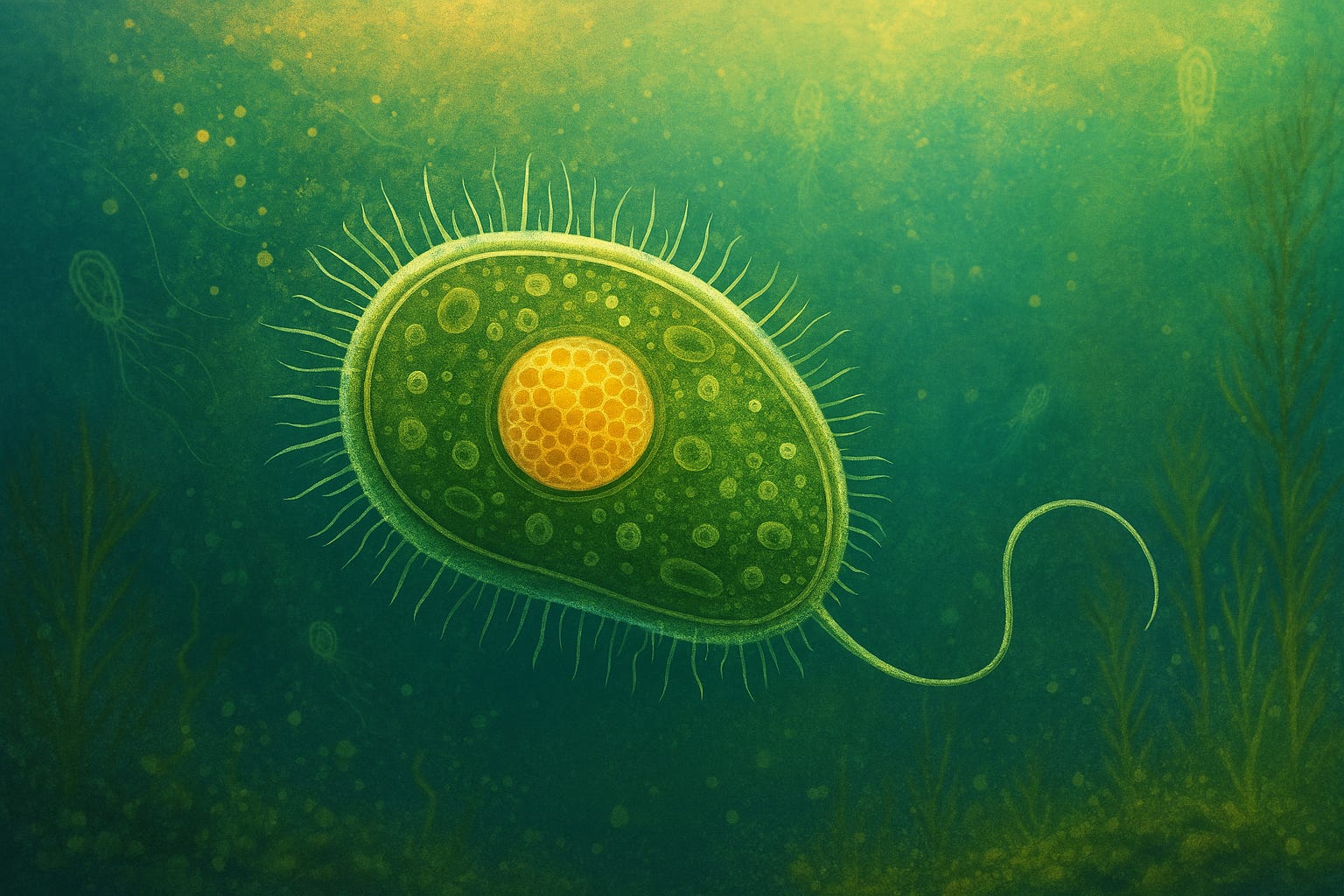
Long before humans, dinosaurs, or even complex multicellular life existed, there was a single entity that connects all living things on Earth. This organism is called LUCA, the Last Universal Common Ancestor. It is the most recent ancestor from which every living species, plants, animals, fungi, bacteria, and archaea, directly inherited its genes. LUCA was not the first life form, nor a modern cell like those we see today. Instead, it was the organism whose lineage survived through billions of years, passing down the genetic foundation of life. It lived in a world vastly different from ours, shaped by volcanic activity, chemical chaos, and a volatile atmosphere.
LUCA lived roughly 3.5 to 4 billion years ago, during Earth’s early Hadean and Archean eons. The planet was harsh, molten rock cooled into seas, volcanic eruptions reshaped the land, and the air lacked oxygen, filled instead with methane, ammonia, and carbon dioxide. Amid these conditions, simple organic molecules, amino acids, nucleotides, and lipids, formed spontaneously, possibly aided by lightning, ultraviolet light, or hydrothermal vents on the ocean floor. These molecules assembled into more complex structures capable of storing information and carrying out basic chemical reactions. From this “prebiotic soup,” life emerged, eventually giving rise to LUCA.
LUCA itself was not the first life. Other forms of life likely existed before it, but LUCA’s lineage is the one that survived. Scientists identify LUCA not from fossils, which are rare for single-celled organisms, but by comparing genes across all domains of life, bacteria, archaea, and eukaryotes. By analyzing shared genes, researchers have reconstructed LUCA’s core genome, estimating it had several hundred genes for essential functions like metabolism, replication, and protein synthesis.
LUCA was a prokaryotic organism, lacking a nucleus. Its genetic material was DNA, transcribed into RNA, and then translated into proteins using ribosomes. Its genetic code closely matches the universal code used by all living things today, reinforcing the idea of a single common ancestor.
LUCA thrived in extreme environments, likely near hydrothermal vents where hydrogen, carbon dioxide, and other simple compounds were abundant. It extracted energy from inorganic chemicals, a process called chemolithoautotrophy, rather than relying on sunlight. Its cell membrane, though simpler than modern cells, could maintain an internal environment and support essential biochemical reactions. These features allowed LUCA to survive in a harsh, oxygen-free world and ensure its genetic longevity.
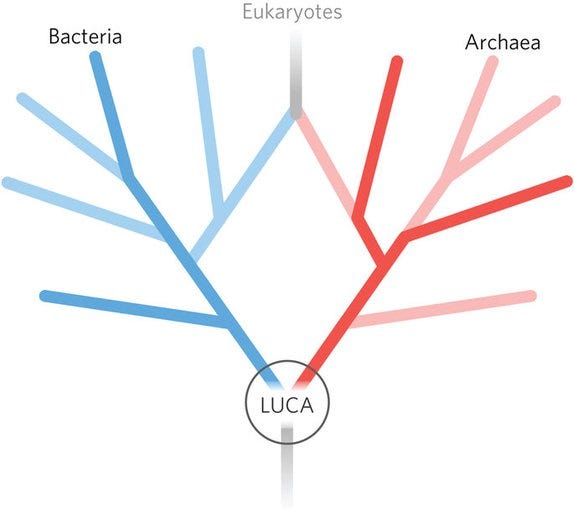
LUCA is the source from which all life diversified. Its descendants split into two main domains, bacteria and archaea. Eukaryotes, plants, animals, fungi, and protists, later arose through processes such as endosymbiosis, where one cell engulfed another and formed a mutual partnership. In this sense, LUCA is a universal link connecting every living organism through billions of years of evolution. Without LUCA, life as we know it would not exist.
Studying LUCA informs modern science in many ways. Its genes and proteins reveal the minimal requirements for life, guiding synthetic biology and the search for life beyond Earth. Extremophiles, organisms living in harsh conditions, offer clues about LUCA’s environment and metabolism.
LUCA emphasizes the unity of life. From bacteria to whales, all living things share a common heritage. Our cells carry a molecular memory of this ancient ancestor, connecting us to the earliest life on Earth. Every heartbeat, every breath, and every biological process traces back to LUCA.
Charles Darwin said, “Therefore I should infer from analogy that probably all the organic beings which have ever lived on this earth have descended from some one primordial form, into which life was first breathed.”
In conclusion, LUCA represents the continuity and resilience of life. It survived billions of years ago in a hostile world, carrying the genetic foundation for all life. From this single ancestor, life diversified into the vast ecosystems we see today.
A quote from Carl Sagan always makes me think of the connection beyond our planet;
“The cosmos is within us. We are made of star-stuff. We are a way for the universe to know itself.”
Further reading;
wikipedia - Last universal common ancestor
Astrobiology at NASA - Looking for LUCA
Bristol University - The nature of the last universal common ancestor and its impact on the early Earth system
Mai’s reflection on LUCA feels like a quiet embrace a reminder that we are, at our core, connected in ways far deeper than bloodlines or borders. There’s something profoundly moving in the idea that every breath we take, every heartbeat, carries the echo of a life form that survived a world of fire and chaos billions of years ago. Her words don’t just inform they comfort. They remind us that we are not isolated beings, but part of a vast, ancient story written in molecules and memory. LUCA isn’t just science; it’s belonging. It’s the whisper of unity in a world that often forgets how deeply intertwined we truly are.
The big question on “what is Life” is really two questions. Can some ingredients coalesce into a unit that can be considered alive and how is it now differentiated from not-life? Perhaps the “life” aspect can be considered the storage and utilization of (useful) energy, usually involving phosphorus which is not usually available in adequate concentrations in places where people assume life originated. Charging and uncharging the phosphorus compounds to store and release energy introduces something like a respiratory process. So you could have a bit of living material known by its ability to process energy.
But the other major question must be addressed - how did the data storage system develop that keeps track of the living system and coordinates its increasing complexity? How exactly did DNA and RNA come into being, the “Book of Life” as it were - who or what wrote that?