
Erasing History
History is not simply a record of the past, it is the foundation upon which societies build their collective identity, morality, and vision of the future.

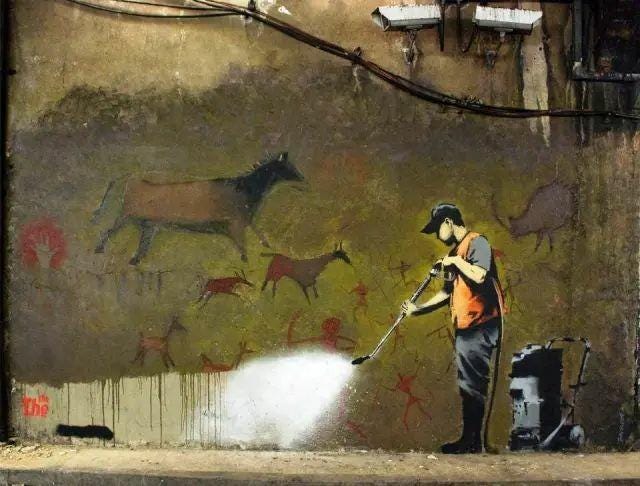
Something a little different to my normal stories. I came across the above image by Banksy and it got me thinking about the erasure of history. Since the beginning of time, human beings have sought to record, remember, and pass down their stories, but just as often, those stories have been deliberately silenced or erased.
History is not simply a record of the past, it is the foundation upon which societies build their collective identity, morality, and vision of the future. To understand where we are, we must know where we have been. Yet throughout human civilization, history has often been subject not just to preservation, but to erasure. Erasure can take many forms, deliberate destruction, distortion, neglect, or silencing of stories that do not fit dominant narratives. It is an act of control, an attempt to shape cultural memory and collective consciousness. By erasing certain histories, those in power assert dominance over not only the present but also the imagination of the future.
The erasure of history is not a phenomenon limited to ancient empires or authoritarian regimes, it is a recurring pattern that spans continents and centuries. From the burning of books in Qin Dynasty China to the rewriting of colonial narratives in textbooks, history has always been vulnerable to manipulation. When people are denied access to their true past, they are denied agency over their identity. Erasure therefore is not just about forgetting, it is an act of violence against truth, memory, and humanity itself.
One of the earliest and most famous examples of historical erasure can be found in ancient Egypt. Pharaohs often sought to obliterate the legacies of their predecessors. Akhenaten, who introduced a radical form of monotheism, was so controversial that after his death his images were defaced and his monuments dismantled, an attempt to remove him from memory entirely. Later rulers engaged in similar practices, chiseling out the names of rivals from stone inscriptions. To erase a name was not merely to destroy a reputation, it was believed to condemn the person to oblivion in the afterlife.
In China, the first emperor Qin Shi Huang, who unified the country in 221 BCE, carried out the infamous "burning of books and burying of scholars." Historical texts and philosophical writings were destroyed to consolidate power and eliminate competing worldviews. By restricting what people could know about their past, the emperor aimed to control their understanding of the present.
The Roman Empire also provides stark examples. Damnatio memoriae, or "condemnation of memory," was a formal practice whereby the Senate erased the names, statues, and images of disgraced emperors. The goal was not only punishment but also to rewrite history so that the ruler seemed never to have existed.
Perhaps the most profound form of historical erasure in modern times is linked to colonialism. European powers, in their expansion across Africa, the Americas, and Asia, did not only conquer land, they also conquered memory. Indigenous histories, traditions, and cosmologies were systematically suppressed. Colonial administrations imposed new languages, religions, and education systems designed to replace indigenous knowledge. Oral histories were dismissed as primitive, artifacts were looted and displayed in European museums stripped of context.
In the Americas, the erasure was particularly violent. Indigenous civilizations such as the Maya, Aztec, and Inca possessed vast libraries of codices and records, many of which were burned by Spanish conquistadors and missionaries. This destruction was accompanied by efforts to Christianize indigenous populations, cutting them off from ancestral practices and memory. What survived often did so in fragments, preserved through oral traditions or hidden from colonial authorities.
Similarly, in Africa, colonial cartography and scholarship framed the continent as "without history" before European arrival. This claim justified exploitation and enslavement, painting African societies as static, uncivilized, and devoid of progress. Such erasure continues to influence perceptions today, obscuring Africa’s rich intellectual, political, and artistic traditions.
The erasure of history is not confined to distant empires or colonial regimes. It is alive in the present day, often disguised as progress or necessity. One manifestation is in the rewriting of school curricula. Textbooks are frequently edited to minimize uncomfortable truths about slavery, genocide, or systemic oppression. In some countries, colonialism is framed as a civilizing mission rather than an extractive and violent project. The complexity of historical figures is reduced to simplified heroism, leaving out the darker aspects of their legacies.
War also provides fertile ground for erasure. When cultural heritage sites are destroyed, whether intentionally or collaterally, a people’s history is jeopardized. The destruction of the Bamiyan Buddhas in Afghanistan by the Taliban, the looting of the National Museum of Iraq during the U.S. invasion in 2003, or the demolition of historic sites in Syria during the ongoing conflict are all examples of how war obliterates not just lives but also memory.
In the digital age, erasure has taken on new forms. The internet has given unprecedented access to information, but it has also created new vulnerabilities. Censorship, disinformation campaigns, and algorithmic biases shape what we remember and what we forget. When search engines privilege certain sources or when authoritarian governments erase dissenting voices from online platforms, the record of history itself becomes unstable. Digital archives can be altered or deleted in ways that leave no trace, making this a particularly insidious form of erasure.
The erasure of history is never neutral. It is always tied to power. Those who erase seek to control narratives to maintain authority, justify dominance, or absolve themselves of guilt. By dictating what is remembered, they influence how future generations interpret justice, morality, and belonging.
For marginalized groups, historical erasure compounds oppression. When the stories of women, indigenous peoples, enslaved Africans, or working-class communities are excluded, their contributions to society are diminished. Without representation in history, these groups face an ongoing struggle for recognition in the present. Feminist scholars have long argued that women’s histories have been systematically silenced, relegated to the margins of historical record-keeping. Recovering those voices has been central to movements for equality.
The erasure of history also affects identity formation. Communities draw strength and cohesion from shared memory. When that memory is disrupted or distorted, identity becomes fractured. For example, the descendants of enslaved Africans in the Americas often face a historical void due to the deliberate suppression of African culture during slavery. This loss has led to inter-generational struggles over belonging and heritage. Reconstructing erased histories is therefore not only an academic exercise but also an act of healing and reclamation.
Despite its persistence, erasure has always been met with resistance. Communities find ways to preserve memory, even under oppression. Oral traditions, songs, rituals, and art have often carried histories that formal archives sought to silence. Indigenous groups worldwide have maintained knowledge of the land, cosmology, and ancestry despite centuries of colonisation.
The stakes of historical erasure are high. A society that forgets its past risks repeating its mistakes. Without knowledge of slavery, colonialism, genocide, or authoritarianism, we may fail to recognize their resurgence in new forms. Erasure fosters ignorance, which in turn enables injustice.
Moreover, history is not only about lessons from the past but also about imagination for the future. If we inherit a distorted or incomplete past, our vision of what is possible becomes constrained. By recovering erased histories, we expand the range of futures we can imagine. We also honor the resilience and contributions of those who came before, ensuring they are not consigned to oblivion.
The challenge for our time is not simply to preserve history but to preserve it inclusively, critically, and honestly. The past is not a static archive but a contested terrain, where silence can be as powerful as speech. By confronting erasure, we reclaim not only the stories of those forgotten but also our collective capacity to imagine a more just and truthful future.
Examples of erasure;
The Burning of the Library of Alexandria (c. 3rd century BCE – 3rd century CE)
One of the most famous acts of cultural destruction in history, the Library of Alexandria in Egypt was gradually destroyed by fire and neglect. While details remain debated, its loss meant the disappearance of countless ancient texts from Greece, Egypt, Mesopotamia, and beyond, erasing vast knowledge of the ancient world.
Damnatio Memoriae in Ancient Rome
Roman emperors and elites could be subjected to damnatio memoriae, meaning their names and likenesses were erased from inscriptions, statues, and records. For example, Emperor Geta (ruled briefly with Caracalla) was deliberately erased from monuments after his assassination in 211 CE.
The Burning of Maya Codices by Spanish Conquistadors (1562)
Bishop Diego de Landa ordered the burning of Maya codices and religious artifacts in Mani, Yucatán. Only four Maya codices survive today. This obliterated much of the written record of Maya history, astronomy, and mathematics.
The Suppression of Indigenous Languages and Oral Histories (19th–20th centuries)
In Canada, the U.S., and Australia, indigenous children were forced into residential or boarding schools where their languages were banned, and oral traditions were discouraged. This was a deliberate attempt to sever cultural memory and identity.
The Partition of India (1947)
During the partition of British India into India and Pakistan, an estimated 10–15 million people were displaced and up to a million killed. For decades, official histories minimized the scale of violence, sexual assault, and displacement, erasing the lived experiences of millions.
The Armenian Genocide (1915–1916) and Its Denial
The Ottoman Empire systematically killed over a million Armenians during World War I. For decades, the Turkish government denied the genocide, erasing references to it in official histories and international discussions.
The Destruction of the Bamiyan Buddhas in Afghanistan (2001)
The Taliban destroyed two monumental Buddha statues carved into cliffs in Bamiyan, which had stood for over 1,500 years. This was an attempt to erase Afghanistan’s pre-Islamic cultural heritage.
The Soviet Union’s Historical Revisions
Under Stalin, photographs and official documents were altered to remove purged individuals. For example, Leon Trotsky, once a key revolutionary leader, was systematically removed from Soviet imagery and history textbooks.
The Cultural Revolution in China (1966–1976)
Mao Zedong’s campaign sought to destroy the “Four Olds” (old customs, culture, habits, and ideas). Countless historical texts, temples, and artifacts were destroyed, and traditional practices were suppressed to enforce a new revolutionary identity.
The Tulsa Race Massacre (1921)
In Tulsa, Oklahoma, a white mob attacked the prosperous Black community of Greenwood, killing hundreds and destroying homes and businesses. For decades, the massacre was omitted from textbooks and mainstream accounts of U.S. history, only gaining widespread recognition in recent decades.
I appreciate your commitment to ensuring the purpose and continued (perpetual) relevance of studying our past. Like ourselves, as individuals, we should be bold in our probing discovery of our social history. Keep it up!
We've seen Confederate statuary and other monuments to people the left in America dislike, like Christopher Columbus, destroyed and removed, and that too is a form of erasure that we shouldn't tolerate.